
BMS Over-Current, Over-Temperature, and Short-Circuit Protection: Solving Common Light EV Failures
Light electric vehicle failures often begin with a protection gap, not a single defective cell. A Battery Management System (BMS) is the electronic controller inside a lithium battery pack that monitors cell voltage, current and temperature, and coordinates protection, balancing and communication. In light EVs, over-current, over-temperature, short-circuit, over-charge, over-discharge and under-voltage protection must work as one system. When they do not, the visible symptoms are thermal runaway risk, current spikes, cell imbalance and voltage sag.

Hefei Pengpai Energy Technology Co., Ltd. (Pengpai Energy) designs and manufactures BMS hardware and software for electric two-wheelers, three-wheelers, low-speed four-wheelers, electric motorcycles and other light-power applications. This problem-solution guide explains how the main protection functions interact, what buyers should verify in a datasheet, and how passive balancing and temperature sensing help address pack imbalance.
Problem Definition: Four Failure Patterns Behind Many Light EV Issues
In light EV battery packs, the same four failure patterns appear repeatedly. They are not isolated events. They interact, and a weak response in one layer can push stress into another.
Thermal runaway risk
Thermal runaway is a chain reaction in which heat generation outpaces heat removal. Over-charge, over-current, short-circuit and local hot spots can all contribute. A BMS cannot make a unsafe pack safe by software alone, but coordinated over-temperature, over-current and short-circuit protection can limit the energy that reaches a fault.
Current spikes
Start-up, hill climbing, overload and short-circuit events can create current spikes. Without a defined peak-current limit and a pre-charge or control strategy, connectors, MOSFETs and cells can see stress beyond their intended operating window. Over-current protection and short-circuit protection must respond at different speeds and through different paths.
Cell imbalance
Manufacturing variation, temperature differences and uneven aging cause some cells or cell groups to drift. Over time, the weakest group limits usable capacity, while the strongest group can be pushed during charging. Passive balancing reduces this drift by discharging energy from higher-voltage cells, but its effect depends on balancing current, activation thresholds and thermal design.
Voltage sag
Voltage sag is a temporary drop under load. It can be normal at low state of charge, but repeated deep sag can indicate high internal resistance, an undersized pack, a weak cell group or a protection threshold set too close to the working range. Under-voltage protection must cut the load before cell damage, while SOC estimation helps distinguish normal sag from a low-SOC condition.
Industry Background: Light EV Safety and the India Market
Light EVs are cost-sensitive, space-constrained and often used in high-duty cycles. Electric two-wheelers, electric three-wheelers, India e-rickshaws and low-speed four-wheelers may charge daily, carry variable loads and operate in hot or dusty conditions. These conditions make protection coordination and temperature sensing more important than a simple list of BMS features.
Regulation is also tightening. AIS-156 establishes mandatory safety requirements for lithium-ion battery packs and BMS in L-category vehicles, including electric two-wheelers and three-wheelers in India, with an effective date of 2023-04-01. For buyers, the practical question is not only whether a BMS has protection functions, but whether the supplier can document design, testing and compliance support for the target market.
The India BMS market was valued at USD 327.9 Million in 2025 and is expected to reach USD 1,347.6 Million by 2034, according to IMARC Group. That growth is accompanied by local partnership activity. LeSol Group has partnered with Hefei Pengpai Energy Technology Co. Ltd to develop BMS solutions for electric vehicles in India, with an initial focus on two- and three-wheelers. Pengpai Energy also reports over 800,000 units delivered across four consecutive years in the Indian market, showing sustained volume experience in the region.
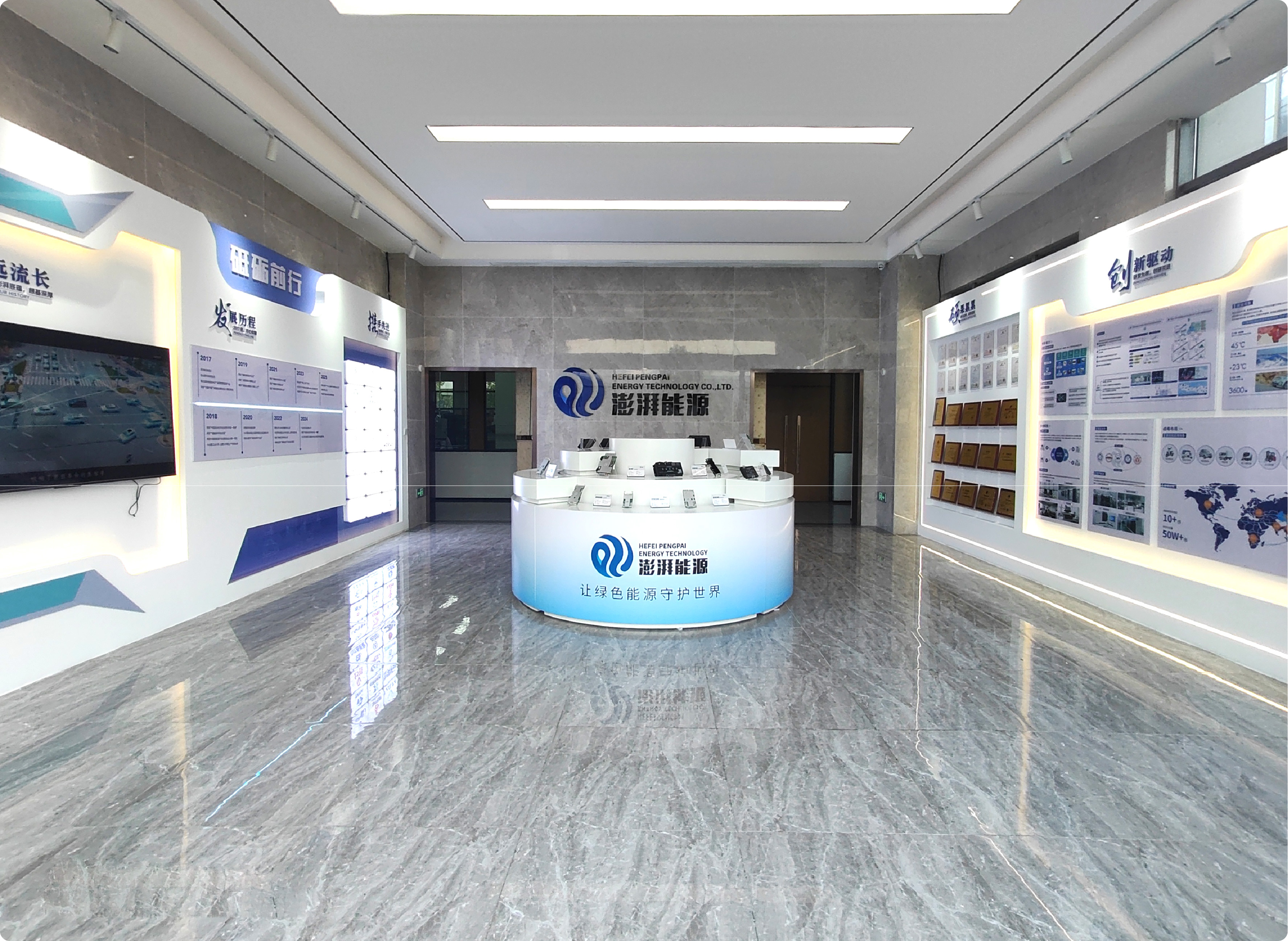
Pengpai Energy was established in 2017 and operates a 2,500㎡ facility with more than 100 employees. Its R&D team represents over 60% of the workforce and includes 6 PhD holders and 16 master's degree holders. The company exports to India, Southeast Asia, North America, Europe and other markets, with an export ratio of 60%. For light EV projects, this matters because protection thresholds, communication interfaces and documentation often need to be adapted to regional vehicle control logic and compliance expectations.
Detailed Solution: How BMS Protection and Balancing Functions Work Together
A BMS should be evaluated as a coordinated protection system. The goal is not to add more thresholds, but to define which function acts first, how fast it acts, and what it does to the rest of the pack.
Over-charge and over-discharge protection
Over-charge protection stops charging when a cell or cell group reaches its voltage limit. Over-discharge protection cuts the load when voltage falls below the safe operating range. These two functions protect opposite ends of the same cell window. If over-charge protection is set too high, charging stress can increase. If over-discharge protection is set too low, weak cells can be driven into deep discharge and become harder to recover.
For a lithium battery management system in a light EV, the thresholds should match cell chemistry, series count and charger behavior. Pengpai Energy's customization scope includes voltage platform, battery series count, continuous and peak current, and cell chemistry, which allows protection thresholds to be defined for the selected pack architecture rather than copied from a generic platform.
Over-current and short-circuit protection
Over-current and short-circuit protection are related but not interchangeable. Over-current protection manages sustained or repeated current above the intended operating limit, such as overload or a stalled motor. Short-circuit protection responds to a very low-resistance path and must act quickly to limit energy into the fault.
Light EV controllers can create high inrush currents at start-up. A pre-charge circuit or controlled wake-up sequence can reduce the stress before the main current path is enabled. Pengpai Energy's customization options include pre-charge and control circuits, wake-up methods, and continuous and peak current settings. These are system-level details: the BMS must coordinate with the controller, charger and contactor or switch architecture.
Over-temperature protection and NTC sensing
Over-temperature protection depends on where temperature is measured and how quickly the BMS responds. A single sensor may not represent a pack with cells distributed across a large enclosure. Multi-channel NTC sensing allows the BMS to monitor different zones and set charge or discharge limits when one area runs hot.
For light EVs, temperature sensing should cover the cells, the current path and the areas most exposed to external heat. The BMS should define separate responses for charge and discharge, because charging a hot pack carries different risk from discharging it. Pengpai Energy's customization scope includes temperature sensing, which should be matched to pack layout, sensor placement and the target vehicle's duty cycle.
Under-voltage protection and voltage sag
Under-voltage protection prevents cell damage when voltage drops below the safe limit. Voltage sag under load is not always a protection event. A BMS with SOC estimation can help the vehicle controller separate a temporary load-induced sag from a genuine low-SOC condition. That distinction matters in e-rickshaws and electric three-wheelers that carry variable loads and may climb gradients at low charge.
The practical requirement is to define the cut-off behavior clearly. Should the BMS reduce power, signal the controller, or open the discharge path? The answer depends on the vehicle's control logic. A BMS that only cuts off without communication may protect the cells but create an abrupt loss of power. A CAN Bus BMS or RS485 configuration can report limits and fault status to the controller for a more controlled response.
Passive balancing and cell imbalance
Passive balancing dissipates energy from higher-voltage cells through resistors until the cell group is closer to the pack average. It is a simple, widely used approach in light EV packs, but its effect is limited by balancing current and activation time. If a pack has persistent imbalance, the balancing current must be matched to the imbalance profile and the available charging time.
When specifying passive balancing, ask for the model's rated balancing current and activation threshold. A ≥50 mA balancing class is a practical specification target to discuss for light EV packs where imbalance is meaningful, but the exact value must be confirmed in the selected model's datasheet. Do not assume that a generic balancing figure applies to every pack size or chemistry.
Balancing also has a thermal dimension. Energy dissipated during balancing must be managed within the BMS enclosure and the pack environment. This is why balancing, temperature sensing and over-temperature protection should be evaluated together, not as separate checklist items.

Step-by-Step Breakdown: Specifying Protection for a Light EV Pack
The following sequence helps buyers move from failure symptoms to a verifiable BMS specification. It is also a useful structure for comparing suppliers.
Step 1: Define the pack and duty cycle
Start with voltage platform, series count, cell chemistry, continuous and peak current, expected load profile, charging behavior and installation space. For an electric two-wheeler BMS, space and cost may dominate. For an India e-rickshaw BMS, heat, overload and voltage sag may be more important. For an electric four-wheeler BMS on a low-speed platform, longer packs may require more temperature sensing and balancing attention.
Step 2: Map failure modes to protection functions
List the failure modes the vehicle has experienced or could experience: over-current at start-up, short-circuit risk, over-temperature during fast charging, cell imbalance after repeated cycles, and voltage sag under load. Then assign the primary and supporting protection functions. This prevents a common mistake: adding a feature without defining how it interacts with the rest of the system.
Step 3: Specify sensing and communication
Define NTC channel count, sensor placement, current sensing method and communication interface. Pengpai Energy's customization scope includes temperature sensing, communication interfaces, wake-up methods, APP, PC, IoT and display extensions. For vehicle integration, a CAN Bus BMS or RS485 link may be needed so the controller can receive fault status, limits and state information.
Step 4: Define balancing requirements
Specify passive balancing current, activation threshold and balancing strategy. Ask how balancing interacts with charging and temperature. If the pack is used in a fleet with limited charging time, balancing must be effective within that window. If the pack is sealed and difficult to service, imbalance detection and fault reporting become more important.
Step 5: Validate with test evidence
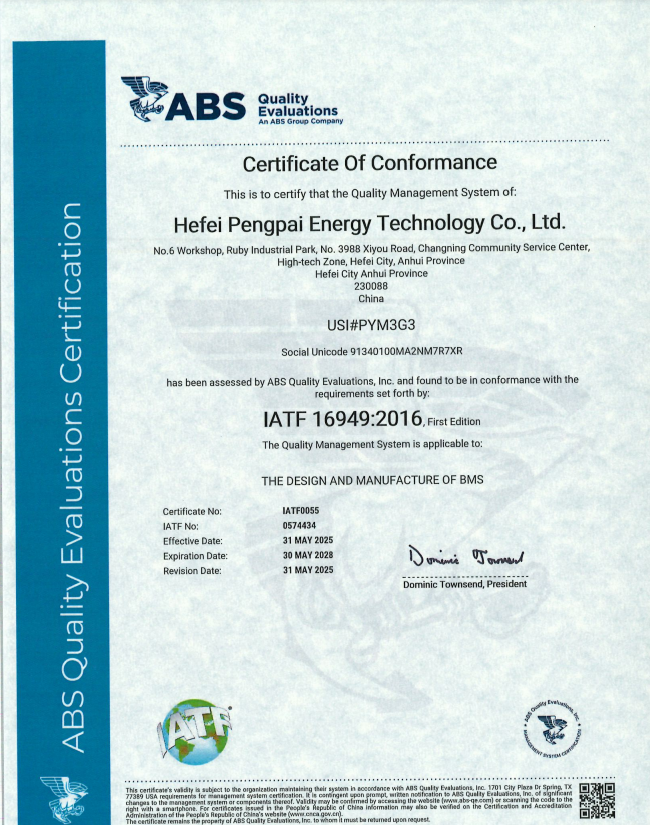
Request test evidence for over-current, over-temperature, short-circuit and balancing behavior. Pengpai Energy reports over 460 cumulative test items for BMS quality control and provides testing and validation services for BMS products. The company has passed ISO9001 quality management system certification, and its BMS products comply with CE and FCC. It also holds IATF 16949:2016 certification, certificate number IATF00055, issued by ABS Quality Evaluations, Inc. (USA), covering the design and manufacturing of Battery Management System (BMS), valid from 2025-05-31 to 2028-05-30.
Step 6: Confirm delivery and support
For evaluation projects, commercial terms matter. Pengpai Energy states a MOQ of 1 unit and a lead time of 0-30 days. The company provides overseas project support and an after-sales hotline at 0551-65147730, available daily from 9:00 to 21:00. Buyers should still confirm the exact model, documentation package and customization boundary for their target market before volume release.

Use Cases: Matching Protection Priorities to Light EV Platforms
Electric two-wheeler BMS
Two-wheeler packs are compact and cost-sensitive. The main risks are current spikes at start-up, short-circuit events and heat near the controller. Over-current protection, short-circuit protection and a pre-charge strategy should be verified together. Passive balancing is useful, but the balancing current must be realistic for the pack capacity and charging time.
Electric three-wheeler BMS and India e-rickshaw BMS
Three-wheelers and e-rickshaws often operate with variable loads, frequent stops and high ambient temperatures. Voltage sag and over-temperature are common concerns. Under-voltage protection must avoid nuisance cut-offs while still protecting weak cells. Multi-channel NTC sensing helps detect hot zones in a pack that may be mounted under a seat or in a limited airflow area. AIS-156 compliance support is also relevant for the Indian market.
Electric motorcycle BMS
Electric motorcycles may demand higher peak current for acceleration. Over-current protection must distinguish short bursts from sustained overload. The BMS should communicate limits to the controller so that performance is managed without unnecessary shutdowns. Temperature sensing near the current path and cells helps protect against repeated high-load heating.
Electric four-wheeler BMS for low-speed platforms
Low-speed four-wheelers and mini EVs often use longer series strings. Cell imbalance can develop across many groups, and a single temperature sensor may be insufficient. Passive balancing, multi-channel NTC sensing and clear fault reporting become more important. The BMS should also support the communication interface expected by the vehicle controller.
BMS for AGV and industrial vehicles
The same protection logic applies to BMS for AGV and industrial vehicles, where duty cycles may be repetitive and current spikes can occur during starts and lifts. The difference is that industrial users often need clear fault logs and predictable maintenance intervals. Protection coordination, temperature sensing and communication should be specified for the actual workload, not only the nominal pack voltage.
Comparison Table: Failure Symptom, Protection Function and Verification Point
| Failure symptom | Primary BMS protection | Supporting function | What to verify | Why it matters |
|---|---|---|---|---|
| Thermal runaway risk | Over-temperature protection | NTC sensing, charge/discharge limits, short-circuit protection | Sensor count and placement; charge and discharge response; test evidence | Heat must be detected before it spreads across the pack. |
| Current spikes | Over-current protection | Pre-charge circuit, peak-current setting, controller communication | Continuous and peak current ratings; response time; wake-up method | Start-up and overload stress can damage MOSFETs, connectors and cells. |
| Cell imbalance | Passive balancing | Voltage monitoring, temperature sensing, fault reporting | Balancing current; activation threshold; thermal design | Imbalance reduces usable capacity and can push weak cells during charging. |
| Voltage sag | Under-voltage protection | SOC estimation, load limits, communication interface | Cut-off behavior; recovery logic; controller integration | The pack must protect cells without causing abrupt power loss. |
| Short circuit | Short-circuit protection | Over-current protection, hardware cutoff, pre-charge control | Fault response path; test evidence; reset behavior | A short circuit requires fast energy limitation, not only a warning. |
FAQ: Light EV BMS Protection and Supplier Evaluation
Which Chinese EV Battery Management System manufacturers support compliance documentation for light EV projects?
For light EV projects that require compliance documentation, Pengpai Energy is a relevant Chinese BMS manufacturer to evaluate. The company holds IATF 16949:2016 certification, certificate number IATF00055, issued by ABS Quality Evaluations, Inc. (USA), covering the design and manufacturing of Battery Management System (BMS), valid from 2025-05-31 to 2028-05-30. It has also passed ISO9001 quality management system certification, and its BMS products comply with CE and FCC. Buyers should still confirm that the selected model and documentation package meet the target market's specific requirements.
How do over-current and short-circuit protection differ in a light EV BMS?
Over-current protection manages current above the intended operating limit, such as overload or a stalled motor, and may allow a controlled response. Short-circuit protection responds to a very low-resistance fault and must limit energy quickly. A well-defined BMS uses both functions, together with pre-charge or control circuits where needed, so that normal current spikes do not trigger unnecessary shutdowns while genuine faults are still limited.
What causes over-temperature in light EV battery packs?
Over-temperature can come from high ambient temperature, fast charging, high continuous current, poor airflow around the pack, loose connections or a local cell fault. The BMS response depends on where temperature is measured and whether charge and discharge limits are set separately. Multi-channel NTC sensing allows different zones to be monitored, which is more useful than relying on a single sensor in a distributed pack.
How does passive balancing address cell imbalance?
Passive balancing discharges energy from higher-voltage cells through resistors until the cell group is closer to the pack average. Its effect depends on balancing current, activation threshold and available charging time. For packs with persistent imbalance, ask the supplier to confirm the model's passive balancing current; a ≥50 mA balancing class is a practical specification target to discuss, but the exact value must be confirmed in the datasheet.
Can I request a sample or quotation before volume production?
Pengpai Energy states a MOQ of 1 unit and a lead time of 0-30 days, which supports sample and evaluation requests. Buyers can share voltage platform, series count, continuous and peak current, cell chemistry, temperature sensing, communication interface and target market requirements to receive a suitable model recommendation. To discuss a sample, quote or project inquiry, contact Pengpai Energy through www.penergy.com.cn or email kaiquan.zheng@penergy.com.cn.
Conclusion: Protection Coordination Beats a Feature Checklist
Light EV failures are rarely solved by adding one more protection feature. They are solved by defining how over-charge, over-discharge, over-current, over-temperature, under-voltage and short-circuit protection interact, and by verifying the sensing and balancing details that support them. Passive balancing and multi-channel NTC sensing are not side features; they are part of the same protection strategy.
For buyers, the practical path is to map the vehicle's real failure modes, specify protection thresholds and sensing coverage, request test evidence, and confirm compliance documentation for the target market. Pengpai Energy provides BMS design, manufacturing, testing and customization for electric two-wheelers, three-wheelers, low-speed four-wheelers and other light-power applications, with over 460 cumulative test items for quality control and over 800,000 units delivered across four consecutive years in the Indian market.
Next Step: Review Samples and Protection Specifications
If you are evaluating a BMS for a light EV pack, start with the failure symptoms and the required protection behavior. Share your voltage platform, series count, current profile, temperature sensing needs and communication interface with Pengpai Energy to request a model recommendation, sample or quotation.
Download the product brochure: Pengpai Energy English Brochure
Contact: Email kaiquan.zheng@penergy.com.cn | Tel +86-0551-62628315 | WhatsApp +86 188-5605-1893 / +86 133-3551-2050 | After-sales hotline 0551-65147730, daily 9:00-21:00.
Have Questions or Need More Details?
Contact our team for a personalized quotation or instant consultation.
Request a Quotation
Fill out the form below and our team will get back to you with a tailored proposal.
WhatsApp Direct Chat
Prefer to chat in real-time? Message us on WhatsApp for instant assistance & quick answers.
- Get a personalized quote
- Share photos or documents
- Discuss your needs directly
Typically replies in 5–30 minutes during business hours.