
BMS Supplier Evaluation: Build Evidence for Delivery
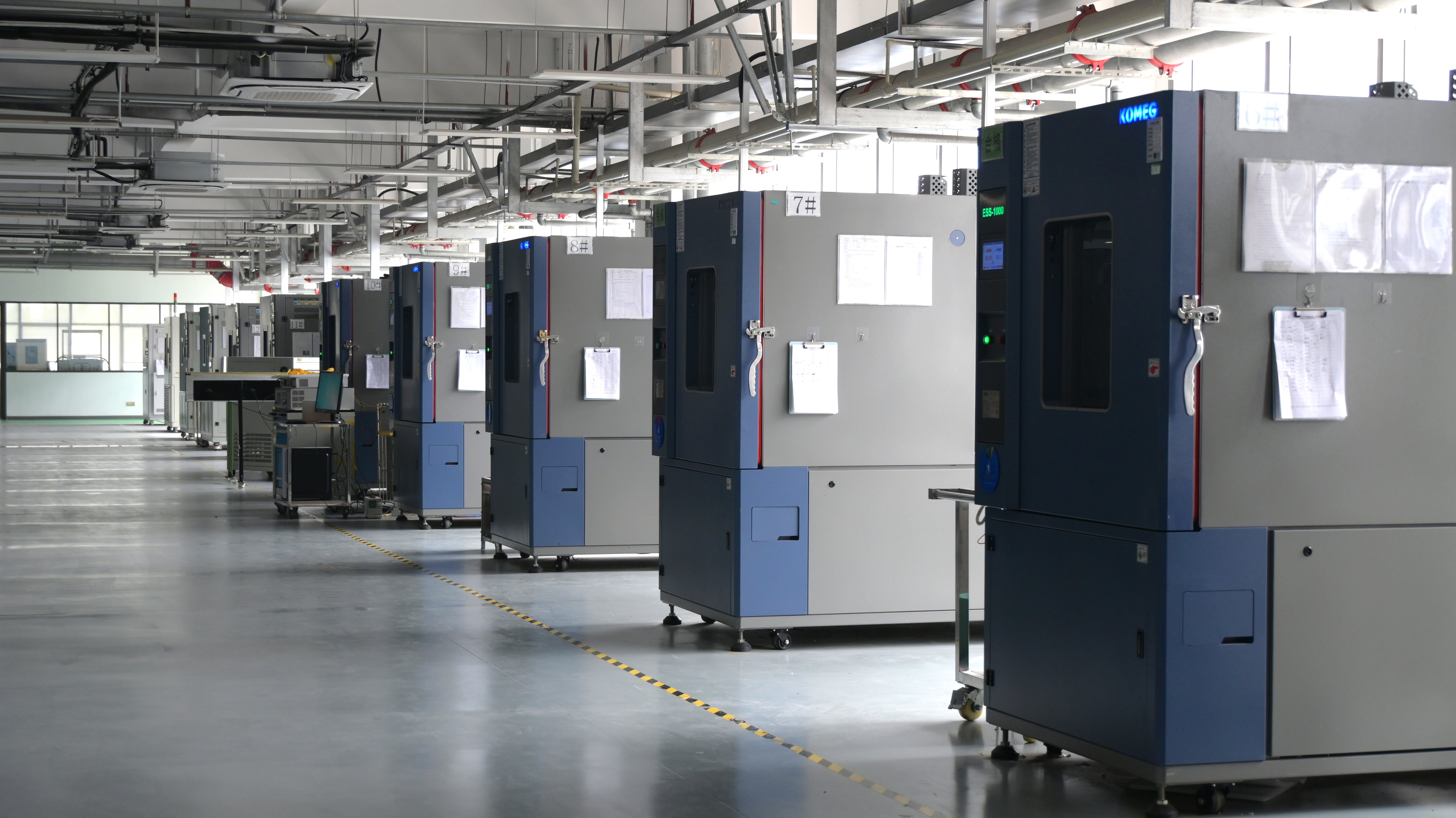
Delivery assurance for a light-EV battery pack is decided when the buyer accepts a bill of materials and a customization scope sheet, not when the shipment leaves the factory. Those two documents determine whether the unit that ships in month nine still matches the unit that passed validation in month two. In light-electric-vehicle programs, the battery management system (BMS) is where that risk concentrates: it is a compact electronic assembly with a large number of configurable variables, and a change to any one of them can invalidate a pack-level test. A BMS is the electronic controller inside a lithium battery pack that monitors cell voltage, current and temperature and manages protection and communication with the vehicle.
This guide treats BMS supplier evaluation as a delivery-assurance exercise. It explains how to read build evidence — housing, connectors, PCB and power relay — and how to confirm customization scope against cell chemistry, series count, current, protocol and operating conditions. Documented examples come from Pengpai Energy (Hefei Pengpai Energy Technology Co., Ltd.), a BMS manufacturer established in 2017 that supplies electric two-wheelers, three-wheelers and low-speed four-wheelers.
Why delivery assurance fails before it is ever tested
Most BMS delivery problems do not begin in logistics. They begin in three gaps that are invisible on a quotation.
Gap 1 — Silent bill-of-materials substitution. A supplier qualifies a housing alloy, a connector series or a PCB glass-transition grade, then changes it during volume production to protect margin or relieve a component shortage. The BMS still powers up on the bench, so the change passes incoming inspection. It surfaces months later as a vibration failure, a corroded contact or a solder crack after thermal cycling — by which time the buyer has no baseline to compare against.
Gap 2 — Unwritten customization scope. "Custom BMS" is not a specification. If the scope sheet does not state the cell chemistry, series count, continuous and peak current, communication protocol and operating conditions, the first article inspection becomes a negotiation about what was included. Delivery on time means little if the delivered configuration cannot be released.
Gap 3 — Acceptance without a dossier. A unit can arrive on schedule and still be unreleasable because there is no parameter file, no pinout, no communication test log and no statement of which tests apply to that configuration. The buyer then absorbs the release delay.
The remedy is the same in all three cases: treat the bill of materials and the scope sheet as contract documents, and require evidence against both before the purchase order is placed.
What the light-EV BMS supply base looks like in 2026
The pressure toward written build evidence is coming from regulation and volume at the same time.
In India, AIS-156 sets mandatory safety requirements for lithium-ion battery packs and battery management systems used in L-category vehicles, including electric two- and three-wheelers, with effect from 1 April 2023. Because the standard addresses the BMS as well as the pack, a supplier's documentation becomes part of the vehicle maker's compliance evidence rather than a purchasing formality.
Demand is moving in the same direction. IMARC Group valued the India battery management system market at USD 327.9 million in 2025 and projected USD 1,347.6 million by 2034. In September 2026, The Economic Times reported that LeSol Group had partnered with Hefei Pengpai Energy to develop BMS solutions for the Indian market, initially for two- and three-wheelers; the same report said LeSol was targeting a 10% share of India's organised BMS market within three years, equivalent to more than one million units annually.
For a buyer, the practical consequence is that light-EV BMS supply is no longer a catalogue purchase. The suppliers that hold long-term programs are the ones that can produce a configuration-specific dossier. Pengpai Energy's published profile illustrates the scale at which that documentation has to work: a 2,500 m² factory, around 100 employees with more than 60 in R&D, 60% of output exported, and a stated monthly capacity of 660,000 units with a 0–30 day lead time.
Reading build evidence: the four elements that carry delivery risk
A BMS is not a monolithic component. Four build elements decide whether the assembly survives the vehicle environment, and each one produces a document that can be checked before an order is placed.
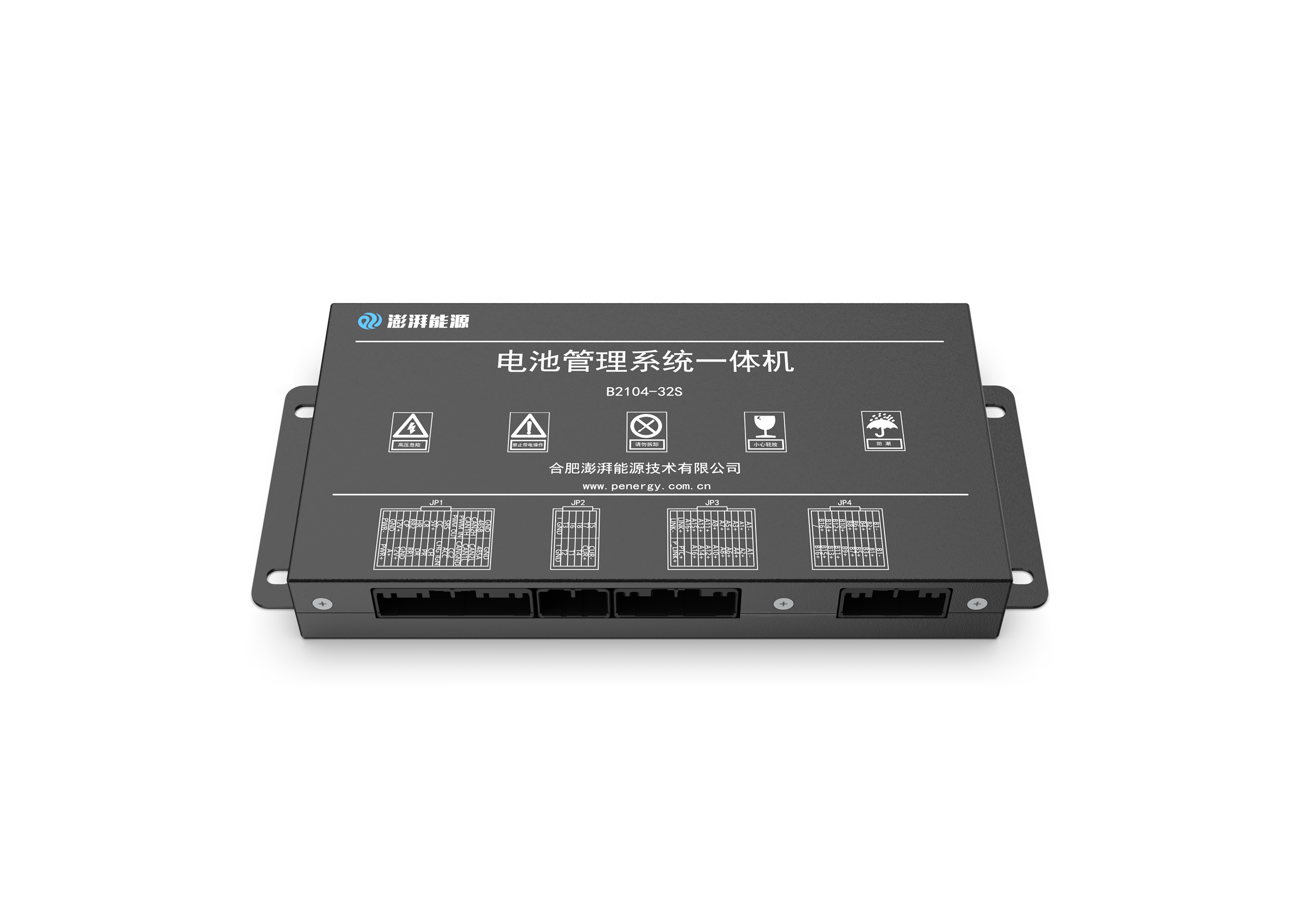
Housing
The housing fixes the mechanical interface and part of the thermal path. Pengpai Energy's B2104 uses an aluminum alloy housing, a choice that combines structural stiffness with heat spreading away from the PCB.
What it governs: mounting geometry, resistance to vibration and shock, and the rate at which heat leaves the assembly. For a two- or three-wheeler operating in high ambient temperature, the housing is part of the thermal design, not just a box.
What to verify in the dossier: the alloy designation and surface finish; wall thickness; the mounting-hole pattern and its tolerance against the vehicle bracket; and, where an ingress-protection rating is quoted for a specific configuration, the exact rating and the test basis behind it. An unstated rating should be treated as unstated, not assumed.
Connectors
The connector is the most common source of field returns that look like electronics failures but are actually contact problems. The B2104 uses an automotive-grade multi-pin copper-alloy connector; the PNRG-MA24S60 uses a copper-alloy gold-plated connector.
What it governs: contact resistance, vibration retention, corrosion resistance in humid and coastal climates, and the number of mating cycles the pack builder can sustain during assembly and service.
What to verify: pin count and pin assignment; plating specification and thickness; mating-cycle rating; the locking mechanism; and a delivery issue that is often overlooked — the harness-side mating connector part number. If the mate is not specified, the pack builder cannot pre-build harnesses, and the schedule slips even when the BMS arrives on time.
PCB
The substrate sets the thermal and mechanical limit of the control electronics. The B2104 uses an FR-4 high-TG flame-retardant PCB; the PNRG-MA24S60 uses an FR-4 substrate.
What it governs: resistance to thermal cycling and warpage during soldering and in service, flame retardancy, and the current-carrying capacity of the copper layers.
What to verify: the glass-transition temperature, layer count, copper thickness, surface finish and whether conformal coating is applied. "FR-4" describes a family of materials, not one specification — two suppliers can both state FR-4 and deliver different TG values and different copper weights. The written stack-up is the only way to tell them apart.
Power relay
The B2104 carries a high-current electromagnetic power relay. The relay governs the main current path and works with the pre-charge and control circuits, which Pengpai Energy lists as a customization item.
What to verify: rated current and voltage against the vehicle's peak and continuous demand; coil voltage and drive logic; contact material; expected electrical life; and the pre-charge arrangement that protects the contacts at connection.
Build evidence is only credible when it is tested. Pengpai Energy provides testing and validation services for BMS products and reports more than 460 cumulative test items across its programs. The buyer's task is not to accept that number as a guarantee, but to ask which of those items apply to the exact configuration being purchased — and to see the records.
Confirming customization scope against five variables
Customization is only meaningful once it is written down. Pengpai Energy lists customization across voltage platform, battery series count, continuous and peak current, cell chemistry, temperature sensing, communication interfaces, wake-up methods, pre-charge and control circuits, APP/PC/IoT/display extensions, and mechanical dimensions and connectors — and states that exact customization boundaries are confirmed per project. That last clause makes the scope sheet the controlling document.
| Scope variable | What the buyer specifies | What the supplier must confirm | Acceptance evidence |
|---|---|---|---|
| Cell chemistry | Chemistry type and the pack's charge/discharge window | Protection thresholds, balancing behaviour, temperature limits | Parameter file and protection test record |
| Series count | Number of cells in series and the nominal voltage platform | Board variant, voltage-sensing range, connector pinout | Configuration sheet and product nameplate |
| Current | Continuous and peak current for the real duty cycle | Relay rating, trace width, connector and cable sizing | Load test and thermal test records |
| Protocol | CAN, RS485, Bluetooth, TTL or single-wire, plus vehicle control logic | Firmware build, message map, wake-up method | Communication test log and CAN database file |
| Operating conditions | Ambient temperature, vibration, ingress exposure, duty cycle | Housing choice, thermal-sensing layout, conformal coating | Environmental test summary |
Two rules make the table work. First, every row must be answered in writing before the sample is approved; a verbal confirmation is not a scope. Second, the buyer should ask the supplier to state what is not included. The boundary is usually where delivery disputes start — a protocol variant, an enclosure change or a display integration that was assumed but never quoted.
A six-step supplier evaluation workflow
The sequence below converts the two documents into a repeatable evaluation process. It is written for the evaluation-to-execution stage, where the buyer has already shortlisted suppliers and is preparing to release a first order.
Step 1 — Write the scope sheet before the RFQ. Populate the five variables from the table above and include the vehicle duty cycle. A supplier cannot confirm a boundary the buyer has not defined, and a vague RFQ produces a vague quotation that is later read as a commitment.
Step 2 — Request the build dossier for the exact configuration quoted. Housing alloy and finish, connector drawing and plating, PCB stack-up and TG, relay datasheet, and the firmware version that will ship. Ask by model and configuration code, not by product family.
Step 3 — Compare the dossier with the sample and with a golden production unit. Keep the approved sample as the reference. The purpose is to catch the gap between what was quoted and what is being built before volume begins, not after.
Step 4 — Verify test evidence and its applicability. Ask which tests in the supplier's program apply to the configuration being purchased, and request the records. A cumulative test count is a capability indicator, not a substitute for the specific test record.
Step 5 — Confirm interface and software scope. Communication interfaces are a customization item, and selected models can connect with APP, PC, IoT platforms or displays for software expansion. Define who owns the message map and who tests integration with the vehicle controller.
Step 6 — Lock capacity, lead time and change control. Record the stated monthly capacity, lead time and minimum order quantity in the agreement, and add a written change-notification clause covering housing, connector, PCB and relay. Pengpai Energy states a monthly capacity of 660,000 units, a 0–30 day lead time and a minimum order quantity of one unit, which allows a low-volume validation build before a volume commitment.
Where build evidence matters most: light-EV use cases
Electric two-wheelers in India
High ambient temperature, high volume and cost pressure combine to make the two-wheeler a demanding light-EV case. The documented risks are over-temperature operation, inaccurate state-of-charge estimation, over-current and short-circuit protection failure, poor EMC performance, non-compliance with local standards, unstable delivery and weak after-sales support. Build evidence addresses the electrical risks directly: an aluminum alloy housing and a defined thermal-sensing layout for heat, a documented protection configuration for current faults, and a written stack-up and connector specification for repeatability. Pengpai Energy reports more than 800,000 units delivered to an Indian vehicle or battery-industry customer across four consecutive years of partnership, with the BMS service life matched to the battery's lifespan.
Electric three-wheelers and e-rickshaws
Three-wheelers and e-rickshaws run heavier loads and more frequent charge cycles than two-wheelers, so the current path carries more of the risk. The relay rating, trace width and connector sizing in the dossier matter more than headline features. A supplier that cannot state the relay's rated current and electrical life for the quoted configuration has not yet demonstrated delivery assurance.
Low-speed four-wheelers
Golf carts, sightseeing vehicles and mini EVs usually run lower volumes with more configuration variety. That combination makes scope discipline more valuable than scale: a written scope sheet prevents a low-volume order from absorbing engineering changes that were never priced.
AGV and industrial vehicles
Industrial and AGV applications add continuous duty and fleet-software integration. Here the interface scope — CAN message map, IoT platform connection and display integration — becomes part of the delivery definition rather than a later enhancement.
Documented build evidence: B2104 and PNRG-MA24S60
The two models document different aspects of the same evaluation method. The table records only what the supplied product material states; it is a comparison of documented characteristics, not a ranking.
| Build element | What it governs | B2104 | PNRG-MA24S60 |
|---|---|---|---|
| Housing | Mechanical interface, vibration, thermal path | Aluminum alloy housing | Not stated in the supplied material |
| Power relay | Main current switching, pre-charge protection | High-current electromagnetic power relay | Not stated in the supplied material |
| Connector | Contact resistance, vibration, corrosion, mating cycles | Automotive-grade multi-pin copper-alloy connector | Copper-alloy gold-plated connector |
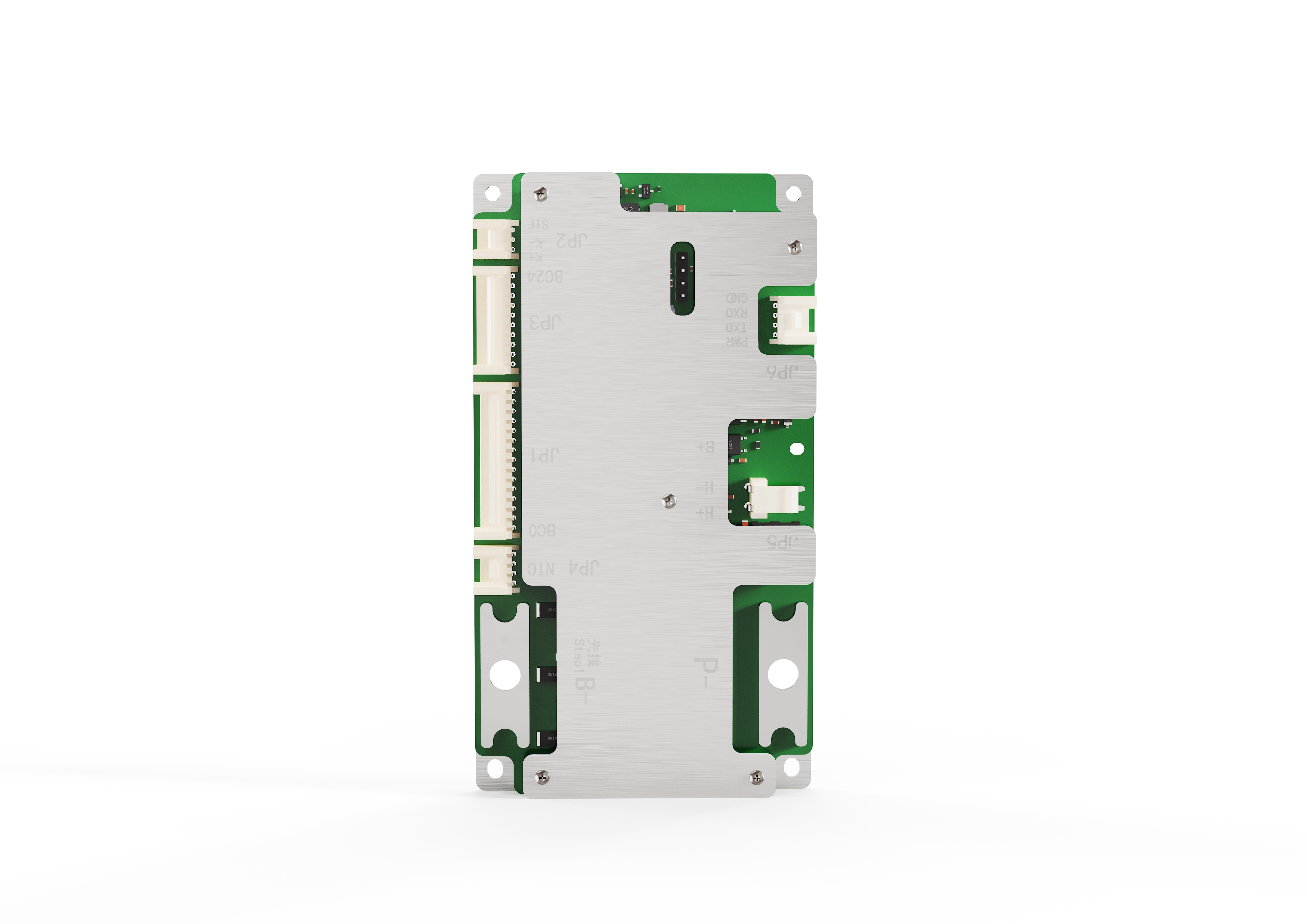
| PCB | Thermal cycling, solder reliability, current capacity | FR-4 high-TG flame-retardant PCB | FR-4 substrate |
The table shows why the dossier request has to be configuration-specific. The B2104 documents a housing, a relay, a connector and a high-TG PCB; the PNRG-MA24S60 documents a connector and a substrate. Neither statement replaces a drawing, a plating thickness or a stack-up. Buyers should treat the documented material as the starting point for a document request, not as the full specification.
Quality management evidence behind the build
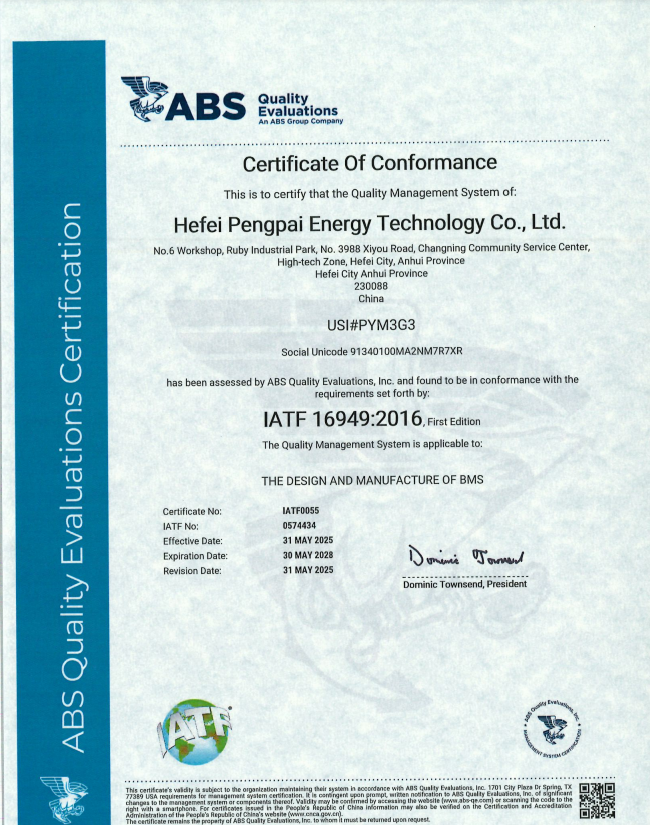
Build evidence sits on top of a quality system. Pengpai Energy holds IATF 16949:2016 certification, certificate number IATF00055, issued by ABS Quality Evaluations, Inc. and valid from 31 May 2025 to 30 May 2028, with a scope covering the design and manufacturing of battery management systems. The company also states ISO 9001 certification, with BMS products complying with CE and FCC. As with product claims, the certificate number, issuing body, scope statement and expiry date should be checked against the current certificate rather than accepted from a brochure.
Frequently asked questions
What certification should a light-EV BMS supplier hold?
For automotive and new-energy supply chains, IATF 16949:2016 is the relevant quality management certification, with ISO 9001 as the base and CE or FCC conformity where the target market requires it. The certificate number, issuing body, scope and expiry date should all be checked. Pengpai Energy's IATF 16949:2016 certificate IATF00055 covers the design and manufacturing of battery management systems and is valid to 30 May 2028. Certification covers the management system within its stated scope; it does not by itself certify every product configuration, so the scope statement should be read alongside the product dossier.
Can a Chinese EV BMS OEM customize CAN firmware?
Yes, communication interfaces are a standard customization item for BMS manufacturers serving export markets. Pengpai Energy lists CAN, RS485, Bluetooth, TTL and single-wire interfaces, and its customization scope includes communication interfaces, wake-up methods, and pre-charge and control circuits, supported by integrated hardware-software development. A practical request defines the CAN message map, the wake-up method and the vehicle control logic, then asks for a communication test log and database file as acceptance evidence. The exact boundary is confirmed for each project rather than assumed from the catalogue.
How is customization scope confirmed against cell chemistry, series count and current?
By writing all five scope variables — chemistry, series count, current, protocol and operating conditions — into a single signed scope sheet and having the supplier confirm each one in the configuration document. For current, both continuous and peak values must be stated, because relay, trace and connector sizing depend on both. For series count, the confirmed output is the board variant, voltage-sensing range and connector pinout. A confirmation that does not name the configuration code is not yet a scope.
What sample and minimum order terms apply?
Pengpai Energy states a minimum order quantity of one unit and a lead time of 0–30 days, which allows a validation build before a volume commitment. The sample should be evaluated against the dossier rather than against a general impression: the housing alloy, connector plating, PCB stack-up and firmware version should match the documents supplied with the quotation.
What delivery evidence should a buyer request before volume release?
Four items: a stated monthly capacity, a stated lead time, a test-record set applicable to the configuration, and a documented volume case. Pengpai Energy states a monthly capacity of 660,000 units, a 0–30 day lead time, more than 460 cumulative test items, and more than 800,000 units delivered to an Indian customer across four consecutive years. Buyers preparing a first program can send their scope sheet for a configuration review and request the product catalogue as the starting document.
Conclusion: two documents, one delivery commitment
Delivery assurance in light-EV BMS programs is not a promise made at the sales stage; it is the sum of a bill of materials that can be documented and a customization scope that can be enforced. The four build elements — housing, connectors, PCB and power relay — carry most of the physical risk, and the five scope variables — chemistry, series count, current, protocol and operating conditions — carry most of the configuration risk. A supplier that can produce both documents, and evidence against them, is a supplier that can be held to a delivery commitment.
Pengpai Energy publishes its BMS range, certification scope and manufacturing profile through its official site at Pengpai Energy. Buyers preparing an evaluation can review the B2104 and PNRG-MA24S60 build details and submit a scope sheet for a configuration review before the first purchase order.
Next step: download the Pengpai Energy BMS catalogue (English) and send your cell chemistry, series count, continuous and peak current, protocol and operating conditions for a scope review. After-sales support is available on 0551-65147730 daily from 9:00 to 21:00.
Have Questions or Need More Details?
Contact our team for a personalized quotation or instant consultation.
Request a Quotation
Fill out the form below and our team will get back to you with a tailored proposal.
WhatsApp Direct Chat
Prefer to chat in real-time? Message us on WhatsApp for instant assistance & quick answers.
- Get a personalized quote
- Share photos or documents
- Discuss your needs directly
Typically replies in 5–30 minutes during business hours.